All or Nothing Mindset: Why a Missed Day Feels Like a Reset (and How to Fix It)
All or nothing mindset turns one missed day into a whole reset. Here is why a streak column feeds it, and how a month score reads a bad week.
By Ultimate Habit Tracker by Cosmo Suite · Editorial policy
Published · 10 min read
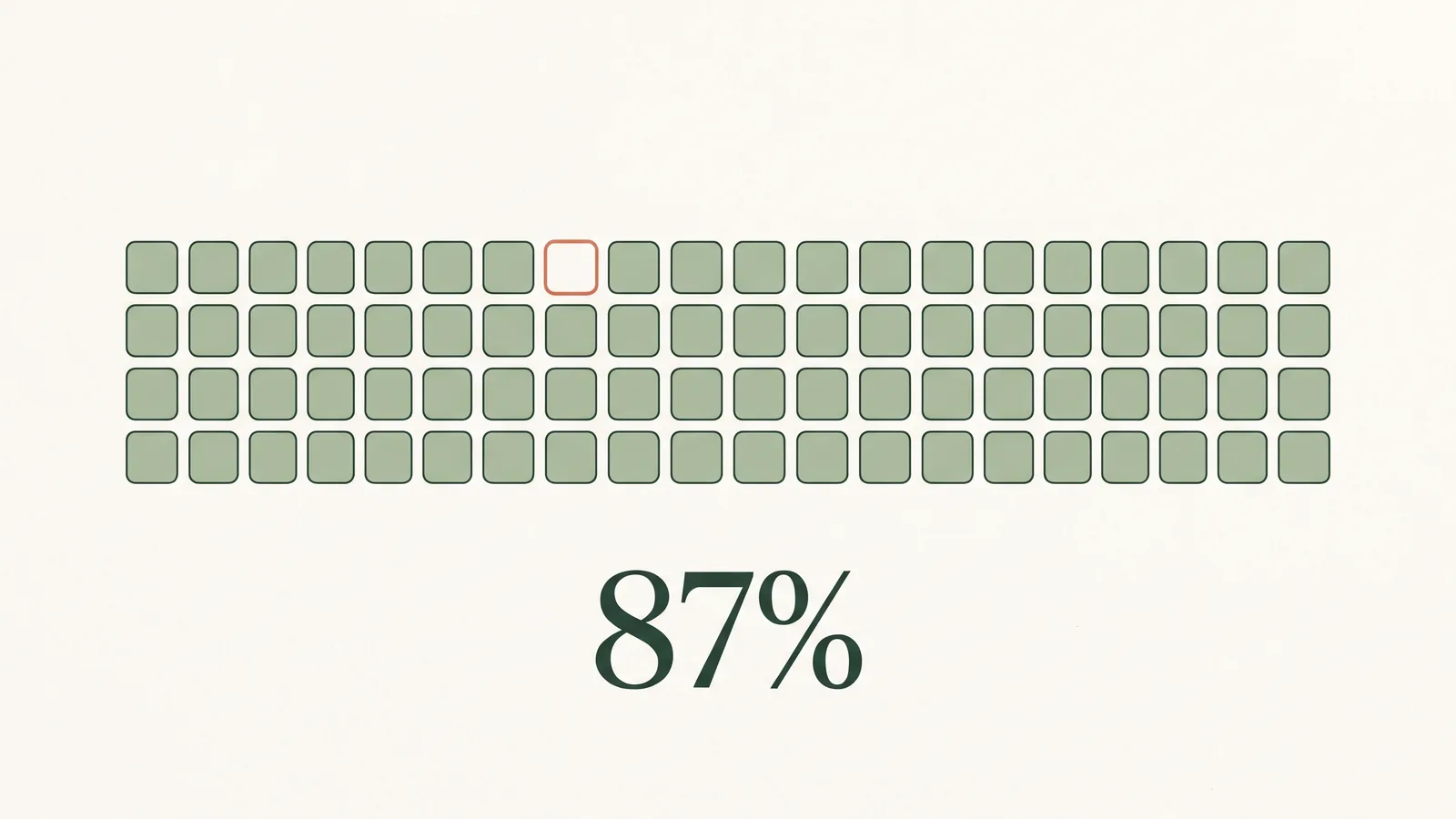
One box is empty on the 12th. The other 29 days have check marks, the month is more than half done, and the tracker shows a zero next to the word streak. That is the moment an all or nothing mindset takes over, and it usually takes over quietly. The month stops being a record of what you did and becomes a record of the day you did not.
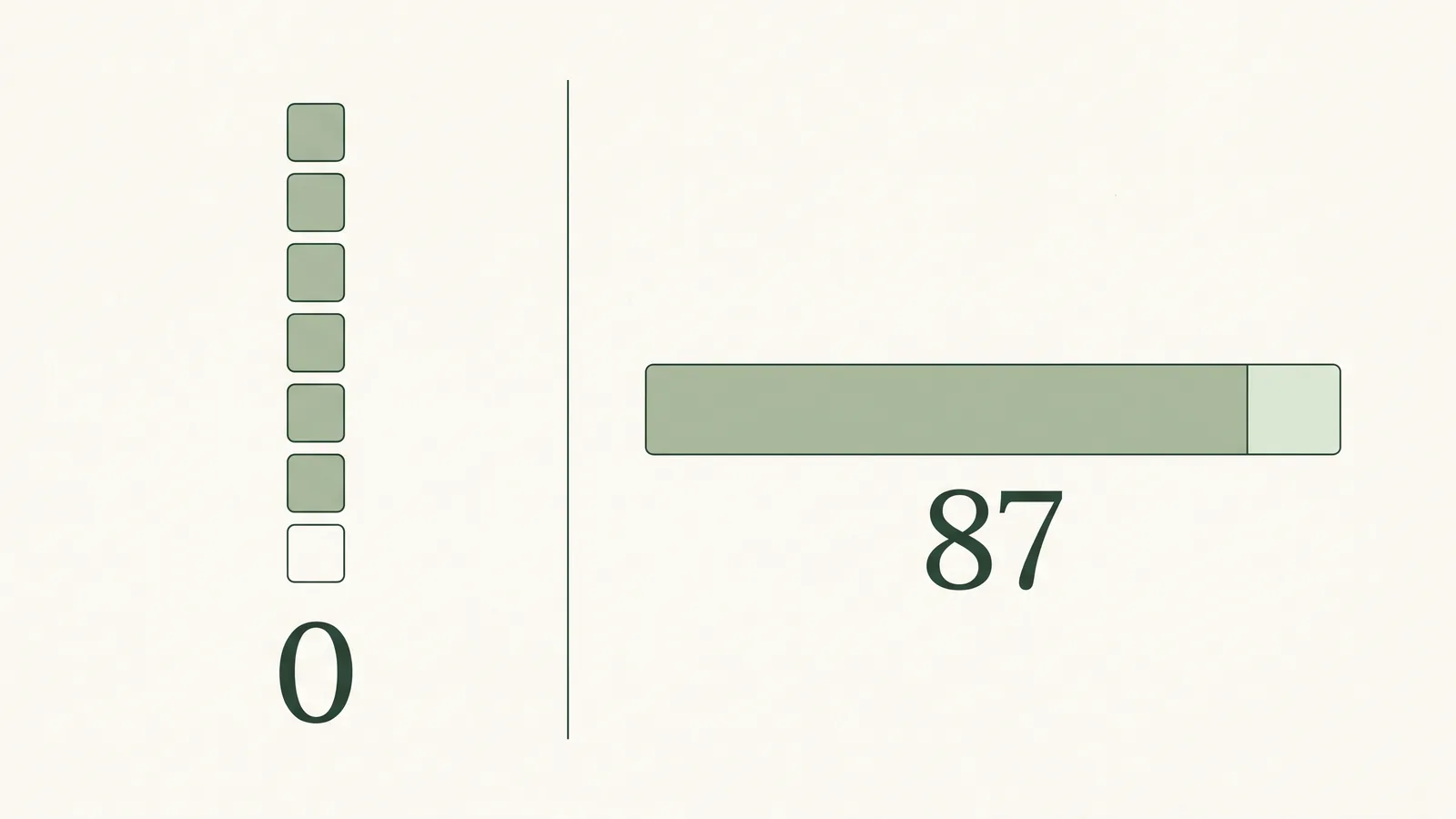
The short answer has two parts. The mindset is real and it has a name in the research. The part that gets less attention is the format of the tracker, which decides how easy that reading is. A streak column holds two values, done and not done. A month percentage holds 101. Same month, same four missed days, two very different verdicts.
The pattern sits in the head, and it also sits in the scoreboard. Most trackers ship a column that can hold two values, so the format repeats the thought back to you.
This article covers how the pattern shows up in habit tracking, what the research says about a single miss, and four changes that give a tracker a second reading. None of it is clinical advice, and nothing here diagnoses anyone. The clinical sources are linked where they matter.
What a Missed Day Does to Your Score
A missed day can mean one of two things in a tracker, and the difference is entirely in the format. In the first reading it is a verdict: the run is over, the column reads zero, and yesterday's work stops counting toward the number you were watching. In the second it is a deduction: one day out of thirty, still visible, still counted.
All-or-nothing thinking is the habit of sorting an outcome into one of two buckets, complete success or total failure, with nothing in between. Psychologists also call it dichotomous thinking, or polarized thinking: the tendency to sort things into the best and the worst without accepting what lies between (APA Dictionary of Psychology). The dictionary entry notes that the term is used for how people read mildly negative events as extremely negative. A missed Tuesday is a mildly negative event. The streak column is what turns it into a verdict.
A month score is the share of planned check-offs you actually marked across a period, counted as a percentage. It is arithmetic on the days the tracker shows, with no grade attached. Four habits across 30 days gives 120 possible check-offs, and the score is whatever fraction of those you marked.
The pattern has a behavioural version too, and it has been studied for decades. Janet Polivy and Peter Herman studied restrained eaters, people who hold a strict rule about what they may eat. When those eaters broke the rule, they often stopped regulating altogether for the rest of the day. Polivy later called the response the "what the hell effect", and it is described as an all-or-nothing approach to self-control (summary of the restraint literature).
The eating research is where the label comes from, and the pattern it names turns up well outside food. Anyone who has thought "I already ruined this week, so I may as well start again on Monday" has run the same script with a different subject.
All-or-Nothing Thinking at a Glance
The table compares what a tracker can show after a missed day. The left column holds the question a reader usually asks, and the next two columns answer it two ways.
| What you want to know | A 0-or-1 streak view | A month score view | Best for |
|---|---|---|---|
| How the month went | A zero if the current run broke | A percentage across all 30 days | Reviewing a month you did not finish cleanly |
| What one miss costs | The whole run | One day out of thirty | Deciding whether to keep going |
| Whether you are improving | Only if the run is longer than last time | A number you can compare month to month | Spotting a trend over several months |
| How to read a bad week | As a failure | As a lower number with a reason | Coming back after travel or illness |
| What to celebrate | A long unbroken run | Every check-off, including the ones after a break | Staying in the habit after a setback |
The table does not say streaks are wrong. A streak answers a real question, which is how consistent you have been lately, and a long run is worth protecting. Trouble starts when the run is the only number on the page.
Why a Streak Column Feeds the All-or-Nothing Read
A streak is a 0-or-1 instrument by design. It tracks one thing, the current unbroken run, and reports it with a single number that resets to zero the moment the run ends. For the question most people ask after a miss, whether the month still counted, that number has no answer.
A streak is the current unbroken run of days on which you completed the habit, counted from the most recent miss. It answers one question, which is how long the present run has lasted.
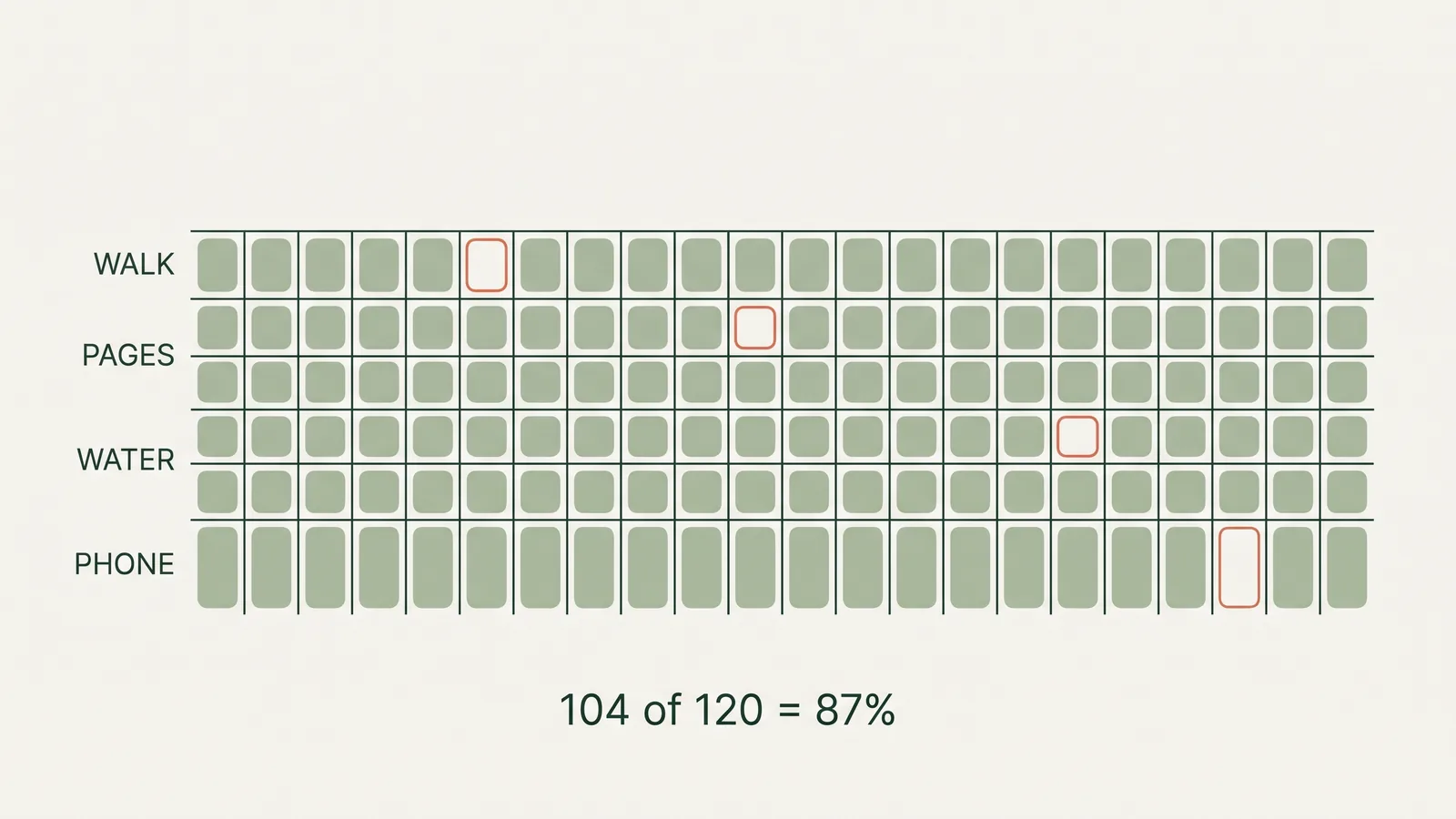
Consider a worked month, using four habits and 30 days: a walk, ten pages, a filled water bottle, and the phone put away by ten. Four habits times 30 days is 120 possible check-offs. Suppose you marked 104 of them and missed 4 days across the whole month. That is 104 divided by 120, or 86.7 percent, which rounds to 87 percent.
The same month reads three ways.
- The streak view: the longest run was 16 days, the current run is 6 days, and a 4-day run sat between them. Two breaks of two days each take the month to 30. If the tracker shows only the current run, the headline number is 6.
- The month view: 87 percent, with the four missed days still visible in the grid.
- The comeback count: two returns after a break, both recorded as deliberate rather than as a fresh start.
None of those numbers is wrong; they answer different questions. The streak answers "how long is the current run", the month answers "how much of the month did I do", and the comeback count answers "how often did I return". A tracker that shows only the first one hands the reader a single verdict on a month with three answers.
The format argument lands here. When the only score on the page can hold two values, the reader has to do the arithmetic in their head to see anything else, and the day after a miss is when that arithmetic is hardest. Put the second number on the page and the reading changes with no extra willpower.
What the Research Says About One Miss
The claim that one miss leads to a collapse has a name in the research, and a body of work trying to explain it.
The most direct recent work is a 2022 paper by Marieke Adriaanse and Pam ten Broeke on what they call the setback effect. The setback effect is the finding that a single failure in self-regulation raises the chance of the next one (Applied Psychology: Health and Well-Being, 14(1)). Their framing is useful because it separates the event from the response. Most everyday failures, they note, are trivial in themselves. What follows is not always trivial.
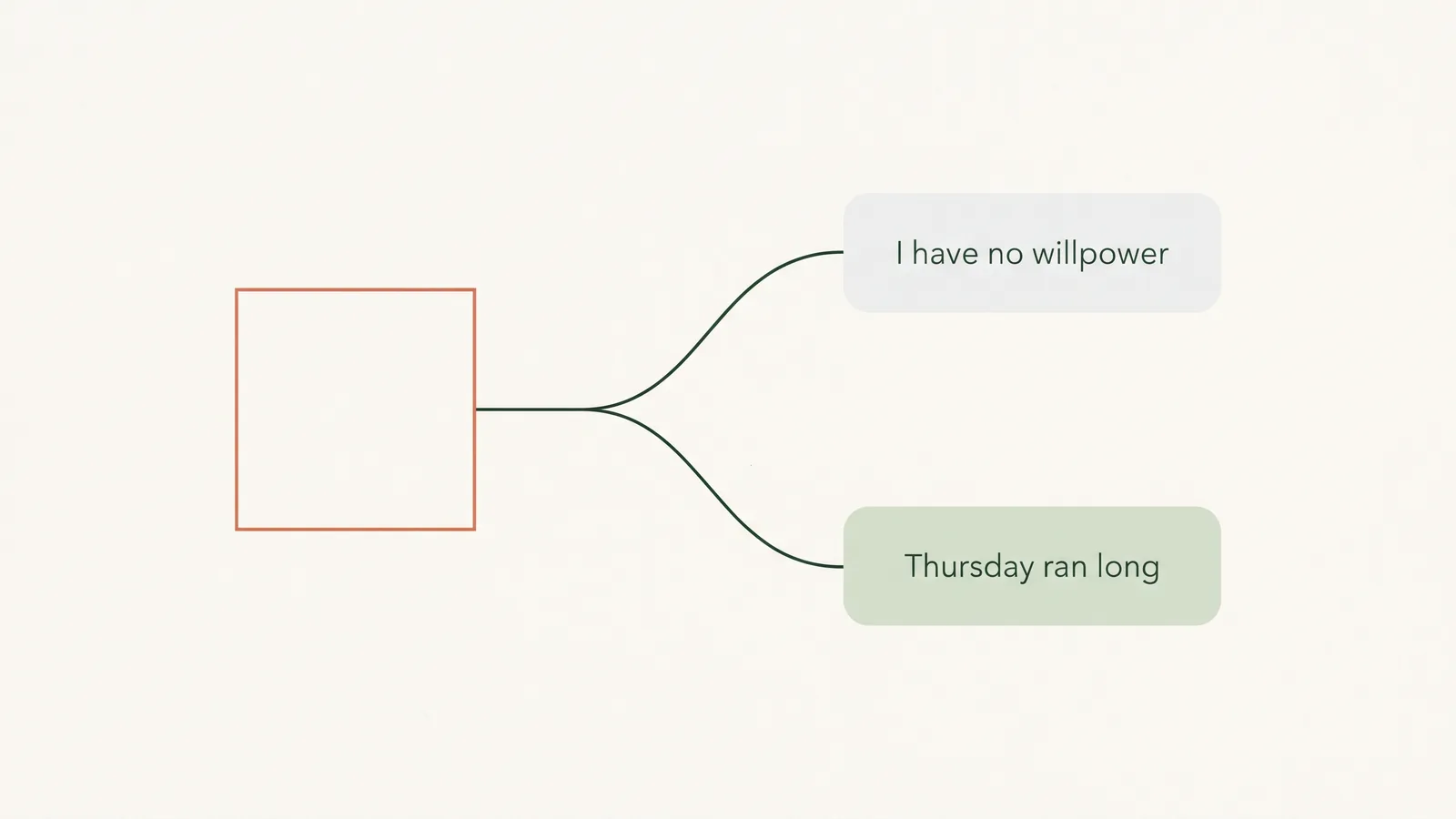
The mechanism they point to is attribution. People are most likely to experience a setback effect when they explain the failure with internal, stable causes, in the language of the paper, which then reduces their belief that they can succeed next time. The version in plain words is "I missed because I have no willpower", as opposed to "I missed because Thursday ran long". The first explanation makes the next miss more likely. The second leaves the door open.
That is close to the older idea from relapse research. The abstinence violation effect is the reaction that follows a first lapse, in which guilt and self-blame can push a person toward a fuller relapse. The model is careful about the important part: the progression from lapse to relapse is not inevitable, and the reaction to the lapse is what tends to decide it (Larimer, Palmer and Marlatt, 1999).
There is a counterweight in the habit-formation literature too. In Lally and colleagues' 2010 study of people building everyday habits, missing the occasional opportunity to perform the behaviour did not seriously impair the process the researchers measured (the study). One missed day, in that data, was not a collapse. The collapse, when it happened, came later and looked more like a change in how the person explained the miss.
Two caveats belong here. These are studies of behaviour in general rather than of any one reader, and none of them tested a spreadsheet. The takeaway is narrow: the story you tell about a miss matters more than the miss, and a tracker either supplies that story or leaves it to you.
Four Moves That Break the 0-or-1 Habit
These are changes to the tracker and to the sentence you say after a miss. None of them asks for more discipline than the habit itself.
Audit the scoreboard. Open your tracker and count the values each column can hold. A checkbox column holds two. A date column holds many. A completion percentage holds 101. If every column that reports on your effort holds two values, the tracker is telling you an all-or-nothing story no matter what you intended. Best for: anyone who has restarted the same habit more than twice.
Put a month total beside the streak. Keep the run if it motivates you, and add the percentage next to it. In the worked month above, the two numbers are 6 and 87, and both are true. Keep the streak. The aim is to stop it being the only reading. Best for: people who quit in the week after a break.
Name the miss in one sentence, then stop. The research points at explanation as the lever, so make the explanation explicit and situational where it honestly is. "I missed Wednesday because I worked late" is a sentence with an end. "I always fall off" is a sentence that predicts the next miss. Write the first one in the notes column and move on. Best for: readers who replay a missed day for the rest of the week.
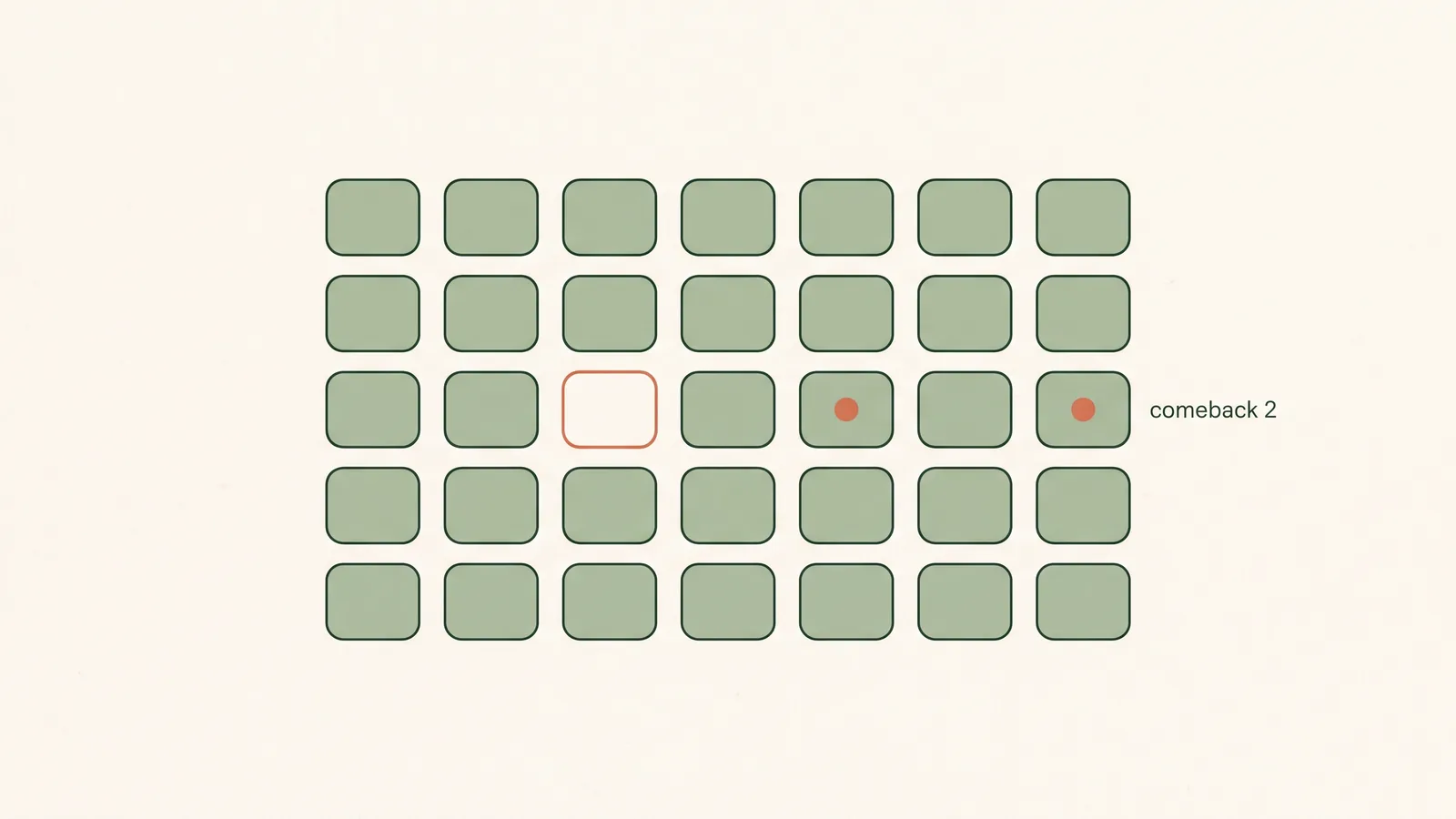
Count comebacks, not just breaks. A return after a break is the behaviour you are trying to build, so give it a number. A month with two comebacks is a month where you came back twice, and that is the number worth growing. Best for: anyone whose streak resets often enough that zero stops meaning anything.
What Actually Keeps You Coming Back
The lever is a score that still means something on a bad day. Motivation fades after a miss, and so does a better morning routine. A number that keeps its meaning does not.
The difference looks small on paper. Two trackers after the same missed Tuesday: in the first, the number goes to zero and the page has nothing to say until the next run gets long. In the second, the number moves from 90 to 87, and the page still shows 29 days of work. The second page gives you a reason to open it on Wednesday, and the first gives you a reason to wait until Monday.
The rest follows from there. If opening the tracker after a miss is unpleasant, you open it less. If you open it less, the record gets thinner, and a thinner record is easier to abandon. By then the all-or-nothing reading has become a feedback loop with the file itself, rather than a feeling about one day.
The practical question, then, is what your tracker shows you on the day after a miss. If the answer is a zero and nothing else, the format is doing the thinking for you.
Why Trust This Article
The Cosmo Suite team makes the Ultimate Habit Tracker, so we have a commercial interest in spreadsheet trackers. We are not clinicians, and nothing here is a diagnosis or a treatment recommendation. The research cited was read on 19 November 2026: the APA dictionary entry for dichotomous thinking, Adriaanse and ten Broeke's 2022 paper, Larimer, Palmer and Marlatt's 1999 overview, the restraint literature summary, and Lally and colleagues' 2010 study. The worked month is an illustration built to show the arithmetic, not a report of anyone's results. Read our about page and editorial policy for how we publish.
Where the Ultimate Habit Tracker Fits
The Ultimate Habit Tracker is a spreadsheet for people who want a month score beside a streak rather than instead of one. It includes 21 tabs across four sections, twelve monthly trackers with a daily checkbox grid, a dashboard, and a Streaks and Comebacks tab that records both the current run and the returns.
The monthly percentage counts every day shown, so the four missed days in a month stay visible as four deductions instead of a reset. One missed day pauses a streak and two in a row end it, which is the never-miss-twice rule built into the sheet rather than left to memory. A forgotten day can be filled in later, and habits typed once in Setup flow into all twelve months.
It runs in Excel and Google Sheets, both included, for $9 once. It has no reminders, by design, so the sheet will not bring you back. The month score is what is meant to. If a two-value scoreboard is the thing that keeps tripping you up, the workbook and its contents show the second number on the same tab. Readers who want the return rule on its own can start with the never-miss-twice guide, and the chain-method breakdown covers what a break does to a visible run. For the wider format question, the habit tracker spreadsheet guide compares the layouts.
Frequently asked questions
Is an all-or-nothing mindset a disorder?
No. Psychologists treat all-or-nothing thinking as a common pattern rather than a diagnosis on its own. It is worth attention when it shapes many areas of your life or comes with low mood. This article covers only how the pattern shows up in habit tracking, so for the clinical side read a source written by clinicians.
Why does one missed day feel like failure?
Because the tracker often reports it that way. A streak column holds two values, done and not done, so a single empty box ends the run and the column says zero. A month percentage holds 101 values, so the same miss reads as one deduction out of 30 days.
Does a streak tracker cause all-or-nothing thinking?
It feeds the pattern more than it causes it. A streak answers one question, how long is the current run, and it answers with a single number that resets. When that is the only number on the page, the reader has no other reading of the month to fall back on.
What is the what-the-hell effect?
It is the name Janet Polivy gave to the response she and Peter Herman observed in restrained eaters: once a rule is broken, the rest of the day gets written off. Researchers have described the same pattern after a single lapse in other behaviours, though the findings do not replicate perfectly across studies.
How do I score a habit month instead of a streak?
Count the check-offs you planned and the check-offs you marked, then divide. Four habits across 30 days is 120 possible check-offs. If you marked 104, the month is 87 percent, and the four missed days stay visible as four deductions rather than a reset.
Is 87 percent good enough to keep going?
That depends on the habit and the month, not on a universal bar. The useful comparison is your own previous month. A month score lets you make that comparison; a streak of zero after a miss does not.
Should I stop tracking streaks entirely?
Not necessarily. A current streak motivates a lot of people, and it answers a fair question about consistency. Keep it if it helps, and put a month total beside it so a break has a second reading. The aim is two numbers rather than one.
Sources
- APA Dictionary of Psychology: dichotomous thinking
- Adriaanse and ten Broeke (2022), Beyond prevention: Regulating responses to self-regulation failure to avoid a set-back effect, Applied Psychology: Health and Well-Being 14(1):278-293
- Larimer, Palmer and Marlatt (1999), Relapse prevention: An overview of Marlatt's cognitive-behavioral model, Alcohol Research and Health 23(2):151-160
- Counterregulatory eating, Wikipedia (summarising Polivy and Herman)
- Lally, van Jaarsveld, Potts and Wardle (2010), How are habits formed: Modelling habit formation in the real world, European Journal of Social Psychology
Keep reading
Habit Tracking
How to Use the Never Miss Twice Rule (Without Starting Over)
Never miss twice can help you restart after a missed session. Learn how to count planned opportunities, handle two misses in a row, and keep a monthly record.
· 8 min read
Habit Tracking
Why Don't Break the Chain Stops Working After One Miss (and How to Fix It)
Don't break the chain can make daily habits visible, but one missed day can erase the streak. See a 30-day example and a calmer way to restart.
· 7 min read
Habit Tracking
Habit Tracker Spreadsheet: How to Build One That Survives a Missed Day
Set up a habit tracker spreadsheet in Excel or Google Sheets that keeps counting after a missed day: the layout, formulas, streak rule and what to track.
· 9 min read
